
Why architects love white!

Richard Dalman
Managing Director, Dalman Architects dalman.co.nz
Why do so many architects dress in black yet design in white?
I’m unsure of the rationale behind the dress code but there are many reasons white has remained one of architecture’s most enduring “colours”. Far from being plain, white is constantly changing, responding to light, landscape, and seasons, revealing a building’s true character.
Unlike darker finishes, white showcases form. As light moves across a white surface, it highlights subtle curves, crisp edges, and considered proportions. Many of history’s greatest sculptures, such as Michelangelo’s David, were carved from white marble, allowing light to dance across every contour, bringing shape and detail to life. Architecture benefits in much the same way.
In Christchurch, white buildings take on a unique personality throughout the day. On “nor-west” afternoons as the sun slips between the clouds and mountains, white facades glow with warm golden tones. On the coast, they reflect the changing blues of the sea, while rippling water casts ever-changing patterns of light.
Indoors, white responds just as beautifully, picking up the warmth of timber floors or the richness of surrounding materials to create interiors that feel inviting rather than stark.
White has long carried symbolic meaning, often associated with purity, truth, and simplicity. These qualities align with the early twentieth century Modernist movement that rejected ornate decoration in favour of clean geometric forms. White became the perfect canvas, allowing the architecture itself – not applied ornament – to become the focus.
The new Christchurch Stadium demonstrates the power of white, as this – combined with its bulk – sees it stand out from its surroundings, and its exposed steel structure is clearly defined.
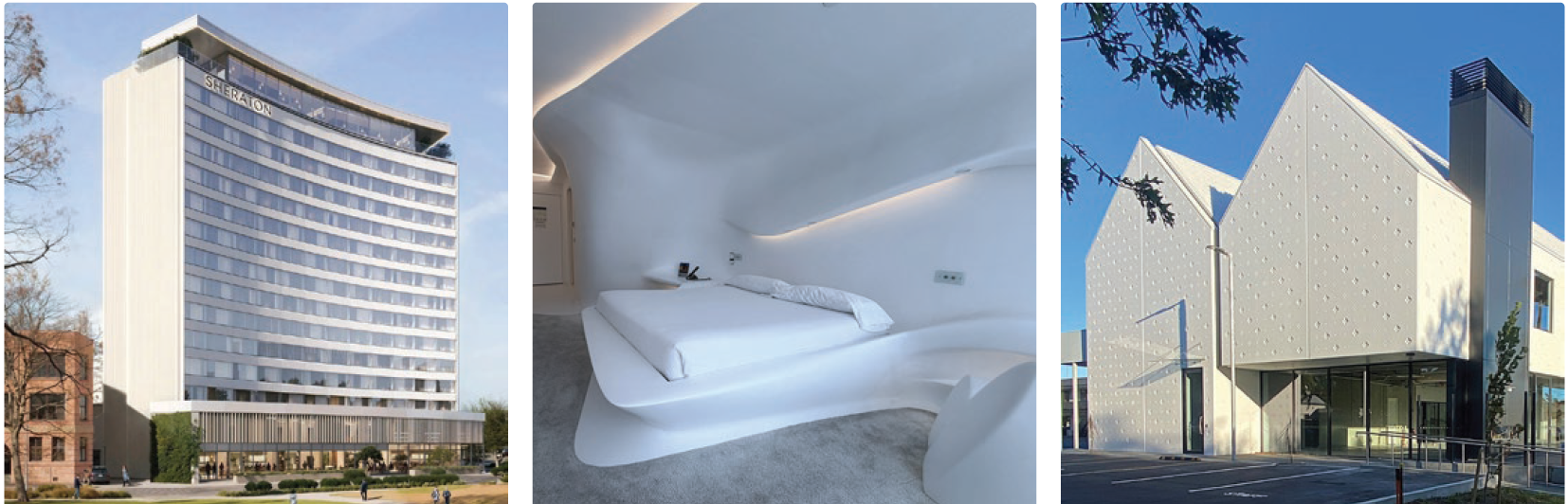
The late architect Zaha Hadid (who often dressed in black), designed numerous white architectural marvels, including a floor of pure white guest rooms in a Madrid hotel. A unique concept, the white accentuates the fluidity of the moulded acrylic forms as the various room elements morph from one into another.
Our own work also illustrates how white can elevate architectural expression. The new river-facing facade on the Sheraton Christchurch, curves along its length where light and shadow interplay, emphasising the purity of the building’s geometry, whilst the Riccarton Road hospitality building’s pattern cast into its white walls, form strong shadows creating depth and interest.
If you have a building you’d prefer to “disappear”, paint it black. But if it is beautiful and you want it to stand out, go with white!